
Once someone buys, marketing usually stops. The order is confirmed, the tracking number email is sent, and then silence.
This is a big mistake. The moment right after a purchase is when trust in your brand is at its highest point in the entire relationship. The person just made a decision in your favor. Right now is when they're ready for the next step, if you talk to them the right way.
Why post-purchase emails outperform promos
Transactional emails get opened 4–8 times more often than regular campaigns. People are expecting order confirmation, so they're motivated to open the email. This is an attention window that most companies waste on nothing but an order number.
Email 1. Order confirmation
Open rate: 70–90%. Yet most companies limit themselves to the order number and delivery date.
What to add beyond order details
- One sentence about what happens next. Not an eight-item list — one line: "We're already preparing your order — the tracking number will arrive tomorrow"
- A link to useful content. If someone bought a coffee machine, link to an article like "How to Make Espresso at Home." Not an ad — help with what they already bought
- A support contact. Not "get in touch" — a specific name and way to reach them

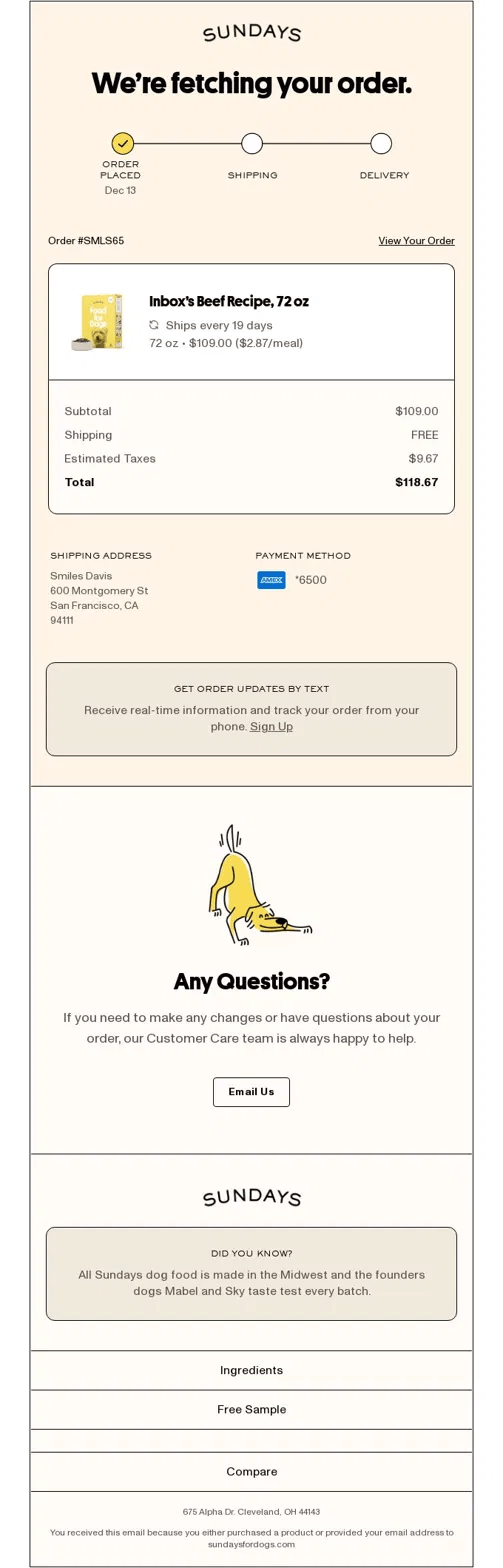
Sundays adds a product fact and links to related pages in its order confirmation — the email works as more than just a receipt
Email 2. Shipping and tracking number
Another email with a high open rate — people want to know where their order is. The tracking number should be clickable and lead directly to the tracking page, not the shipping company's homepage.
- Feature the expected delivery date prominently. Not in small print among the details — in the first paragraph
- Instructions on what to do upon delivery. Especially important for fragile items or ones that need to be checked with the courier
Email 3. Review request
Send it 3–7 days after delivery — enough time to try out the product, but not so much that the impression fades.
The most common mistake is a long text explaining why reviews matter to the company. The customer doesn't care what the company needs. They care about spending as little time as possible.
- A short email. Literally: "How do you like [product name]?" plus two or three rating buttons right in the email
- A specific product. Not "rate our store" — "rate [specific product name]"
- A personal message from a real person. An email from a founder or manager converts better than a corporate "the store team"

J.Crew asks about each product individually — the customer sees exactly what they're being asked to rate, not the store as a whole
Email 4. Upsell
7–14 days after the purchase — once the person is already using the product — you can offer something related.
The logic is simple: bought a coffee machine — offer coffee and cleaning tablets. Bought sneakers — offer insoles. Bought a course — offer the next level.
What doesn't work in upsell emails
- Showing the entire catalog. One or two specific offers convert better than "check out what else we have"
- Offering the exact same thing someone just bought
- Doing it too early. An upsell email a day after the purchase looks like a cash grab

Audible shows three recommendations tied to the genre of the book purchased — specific offers, not the entire catalog
Email 5. Reactivation after 60–90 days
If someone hasn't come back since their first purchase, you can send a win-back email two or three months later.
"Long time no see" doesn't work as a subject — it sounds templated. It's better to tie it to something specific: "You bought [product name] three months ago — how's it working out?" Or highlight something new in the category they bought from before.
More on win-back mechanics: letteros.com/blog/marketing/pisma-dlya-vozvrata-ushedshih-klientov-sczenarii-i-primery/
What the full sequence looks like
When | Purpose | |
|---|---|---|
Order confirmation | Immediately | Information + first impression |
Tracking number | After shipping | Status + reducing anxiety |
Review request | +3–7 days after delivery | Social proof |
Cross-sell | +7–14 days | Repeat purchase |
Referral | +14–21 days | Attracting new customers |
Reactivation | +60–90 days | Win-back if they haven't repurchased |
More on trigger sequences: letteros.com/blog/sovety/triggernye-rassylki-dlya-uderzhaniya-klientov-sczenarii-vozvrata-i-povysheniya-loyalnosti