
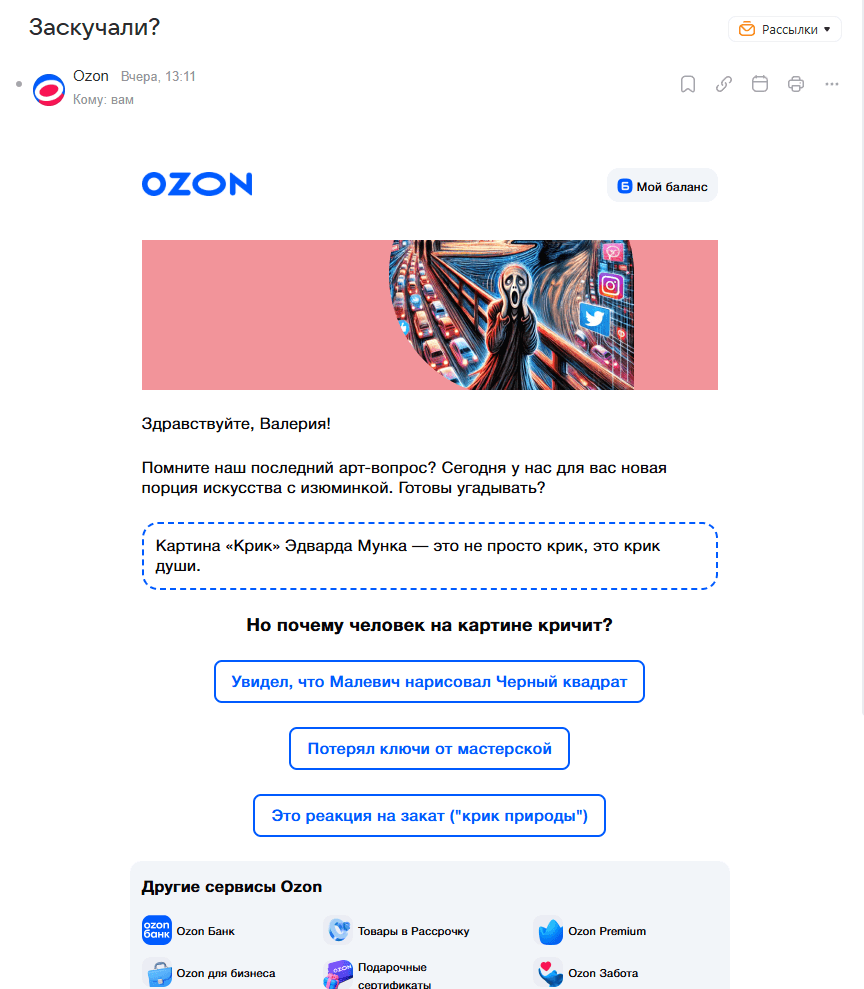
Acquiring a new customer costs several times more than winning back someone who's already made a purchase. A returning customer already knows the product and trusts the brand, so they decide faster. Yet most companies don't work with churn systematically — they just wait for people to come back on their own.
Win-back emails have become one of the most underrated tools in marketing. In this article, we'll break down exactly who counts as a lost customer, which scenarios deliver the best results, and how to structure your communication correctly.
Who counts as a lost customer
A lost customer is someone who has stopped making purchases. Segmentation criteria depend on the specifics of the business.
- E-commerce: no purchases within 90–180 days.
- SaaS: no activity in the account for 30 to 60 days.
- Subscriptions: cancellation of a service renewal.
- Services: no requests for over six months.
It's important to distinguish between a lost customer and an inactive subscriber. The latter might not open emails but keeps using the product. A lost customer, on the other hand, completely ends their financial or operational relationship with the brand.
Reasons for leaving
The right win-back scenario depends directly on why the person stopped buying.
- Forgetfulness. The customer was satisfied but has no trigger to remind them about the company. This is the largest category.
- Looking for an alternative. A competitor offered a better price or a higher level of service. In this case, winning them back requires a compelling argument.
- A negative experience. Issues with delivery or product quality require the brand to acknowledge the mistake.
- A change in context. The need for the product disappeared due to a move or a completed task. Here, a comeback is only possible if new circumstances arise.
To better understand your audience's motivations and prevent losing them, we recommend checking out our material on why people unsubscribe from newsletters and how to stop it.
Email scenarios
1. Reminder This is the simplest, no-pressure way to reach out. It works for people who left "quietly."
- Acknowledge the pause in communication with a short, neutral message.
- Share recent changes or new products.
- Give one concrete reason to come back, like a catalog update.
- Add a light call to action.
- Example subject line: "Long time no see — check out what's new."

2. Special offer If a simple reminder didn't work, it's worth offering an incentive — a discount or free shipping. Important: don't open the sequence with bonuses right away. If the customer gets a discount in the very first email, they'll learn to ignore you until there's a deal on the table. Save the discount for the third message.
- Craft a personal offer with clear terms.
- State a real expiration date for the deal.
- Example subject line: "Just for you — 15% off your next order."

3. A clarifying question This approach works well for SaaS and services. The goal is to find out why they canceled.
- Calmly acknowledge that they've left, without any accusatory tone.
- Ask one question about their reasons.
- Offer answer options as buttons or a short form.
- Example subject line: "You canceled your subscription — is there something we can fix?"

4. An email about what's new This option works when a customer left because a product or feature they needed wasn't available. Directly addressing that objection with an announcement of changes can be the deciding factor in getting them to come back.
- Name a specific new feature that solves the user's problem.
- Explain the benefit of this update specifically for them.
- Invite them to try the changes for themselves.
- Example subject line: "We added what you were missing."

How to structure the sequence
A single email rarely gets results, so it's better to set up a series of three emails with an escalating incentive.
Day 1: a soft reminder focused on specific changes.Day 7: useful content or a rundown of new features.Day 14: a final, time-limited offer.
If there's no response after the third email, it's better to stop. Further attempts only annoy the recipient and hurt your domain's reputation. To automate this and dig deeper into the mechanics, read about win-back and loyalty-building strategies through trigger emails.
Common mistakes
- Using generic templates. A phrase like "We miss you" sounds insincere. Replace it with facts about what's changed at the company.
- No segmentation. A newcomer and a loyal customer need different approaches.
- Weak personalization. A greeting like "Dear Customer" comes across as a failure these days. Use their name and details about their last purchase.
How Letteros helps with customer win-back
In the Letteros builder, trigger sequences are as simple as possible to set up. You can create a single master template so every email in the series keeps your brand style and reads as one cohesive communication.