
A newsletter is one of the hardest formats to get right. Unlike a promo email, it doesn’t have one clear goal. It has to be interesting in its own right, so people open it not for a discount, but because they’re looking forward to it. Let’s break down what content works and how to structure an issue.
How a newsletter differs from a promo email
A promo email solves one task: sell, register, download. It has an offer, a deadline, and a button.
A newsletter works differently. Its job is to maintain a relationship with the audience and build trust and expertise. Sales here are indirect: a person reads the newsletter for months, gets used to the brand — and when it’s time to buy, they choose the brand they trust.
This means every issue needs to offer something useful or interesting on its own, without an offer attached.
Company news
The most obvious format — and the most dangerous one. Company news is only interesting to the reader if it directly affects them.
What works. Launching a new product or feature — if you explain what it changes for the user. Operational changes — new terms, a change of address, updated pricing. Period recaps — what you did, what didn’t work, what’s planned.
What doesn’t work. “Our company is celebrating its 10th anniversary” with no context for why the reader should care. “We spoke at a conference” with no concrete takeaways from it. “We’re excited to announce” is almost always a sign that something boring follows.
The rule is simple: company news becomes interesting when it answers the question “what does this mean for me?”

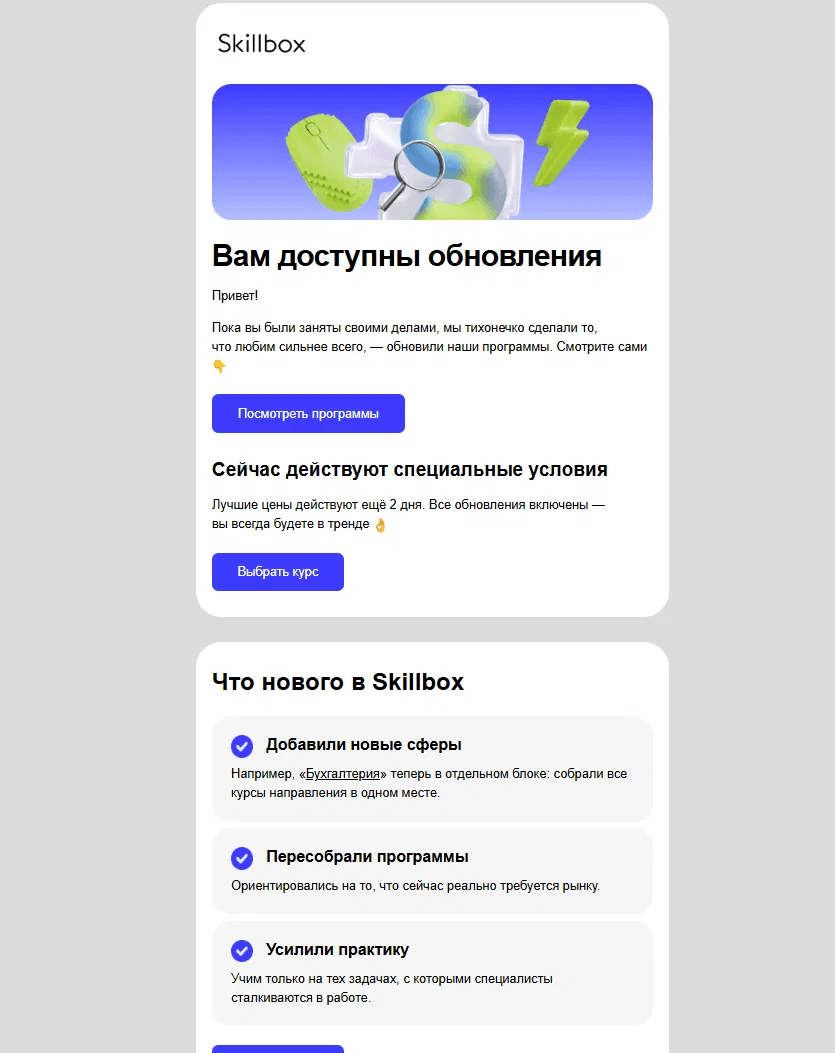
Skillbox talks about platform updates from the user’s point of view — not “we added,” but “new features are now available to you.” Every change is explained in terms of the benefit to the student.
Industry news and trends
Subscribers read you because you know the subject. Show it: round up important industry news and comment on it from your own perspective.
Don’t just retell the news — the reader could have found it themselves. Add interpretation: why it matters, what will change, how it affects your customers’ work.
Useful content
How-tos, checklists, roundups, breakdowns — content that solves a specific problem for the reader. This is the most reliable format for retaining an audience.
A few ideas for different niches.
A service for marketers — a customer case breakdown with real numbers, a pre-launch campaign checklist, a roundup of tools.
An online store — a product selection guide, care instructions, a seasonal roundup.
A B2B company — a breakdown of a common customer mistake, answers to support questions, a review of industry changes.
An educational project — a practical assignment, a breakdown of a common student mistake, a roundup of extra materials.

Behind the scenes and the team
People read about people more readily than about companies. Show who’s behind the brand, how decisions get made, what happens on the inside.
Formats: an interview with an employee, the story of how a product was created, the team’s workflow, an honest account of a failure and the lessons learned.
This kind of content builds an emotional connection with the brand — and it’s hard for competitors to copy.

Customer stories
A real person, a real problem, a real result. Not a case study in report format, but a living story: what they came with, what changed, what it looks like now.
These emails work on several levels at once: they show the product in action, build social proof, and let the reader recognize themselves in the story’s protagonist.
Questions and engagement
A newsletter doesn’t have to be a monologue. Emails that ask for the reader’s opinion get replies — and that’s live feedback.
Formats: an open question asking readers to reply directly to the email, a two-option poll, a request to share experience related to the issue’s topic.
Replies to these emails give you audience data, topics for future issues, and raw material for content.
Roundups and digests
Once a week or once a month — a roundup of useful finds from different sources. Articles, tools, books, research related to your niche.
Including other people’s material is fine — even necessary. It shows you’re keeping an eye on the industry and thinking about the reader’s benefit, not just self-promotion. These emails often get forwarded to colleagues.

Mindbox Journal is a weekly digest of cases and materials. Each block is tagged with who it’s relevant for, so the reader instantly sees what they need.

Seasonal and event-driven content
Tying an email to a current context makes it timely. The start of a quarter, an industry holiday, a major industry event — these are all natural occasions for an issue.
Important nuance: the content needs to be genuinely tied to the occasion, not just mention it in the subject line. An email that says “Happy New Year! And here are our prices” doesn’t work.
How to choose the structure of an issue
A newsletter can be built around a single topic for the whole email, or as a digest of several blocks.
A single topic. An in-depth piece that gets read in full. Works well for expert and content-driven newsletters where the audience values a detailed breakdown.

A digest. Several short blocks on different topics. The reader chooses what to click. Works well for media outlets, agencies, and companies with a broad audience.
Both structures work — the choice depends on what your audience expects and what kind of writing you’re good at.
What makes a newsletter regular
The main problem with newsletters is irregularity. Three emails in a week, then silence for a month. Subscribers lose the habit of opening them.
A few principles that help.
Fix a send day and stick to it. Readers get used to receiving the email on Tuesdays — and start looking forward to it.
Plan topics ahead of time, at least a month out. Not a detailed script, but sections: news, value, story. It’s easier to come up with a specific topic once the format is set.
Make the work easier on yourself. If an issue takes three hours to produce, you’ll keep putting it off. A template, fixed sections, and a content plan cut down production time.
Bottom line
A newsletter works when every issue gives the reader something worth opening the email for. Company news, useful content, customer stories, a take on industry trends — any of these formats works as long as it’s concrete and respects the reader’s time.
Also read: