
Most email campaigns lose subscribers because of repetitive content: discounts, sales, "seasonal arrivals" email after email. The subscriber gets used to it, stops opening, and unsubscribes.
Meanwhile, the list is already loyal — the person gave their email themselves. All that's left is to give them a reason to open the next one.
Below are 30 ideas, grouped by format. Concrete topics you can add to your plan today.
Value and education
The most resilient format. Useful emails get opened even by people who haven't bought anything in a while, because they solve a problem.
1. A product walkthrough Show a non-obvious use case subscribers wouldn't think of on their own. A clothing store explains how to wash wool without shrinking it. An analytics tool shows how to configure a dashboard for a specific task. Emails like these get saved and revisited.

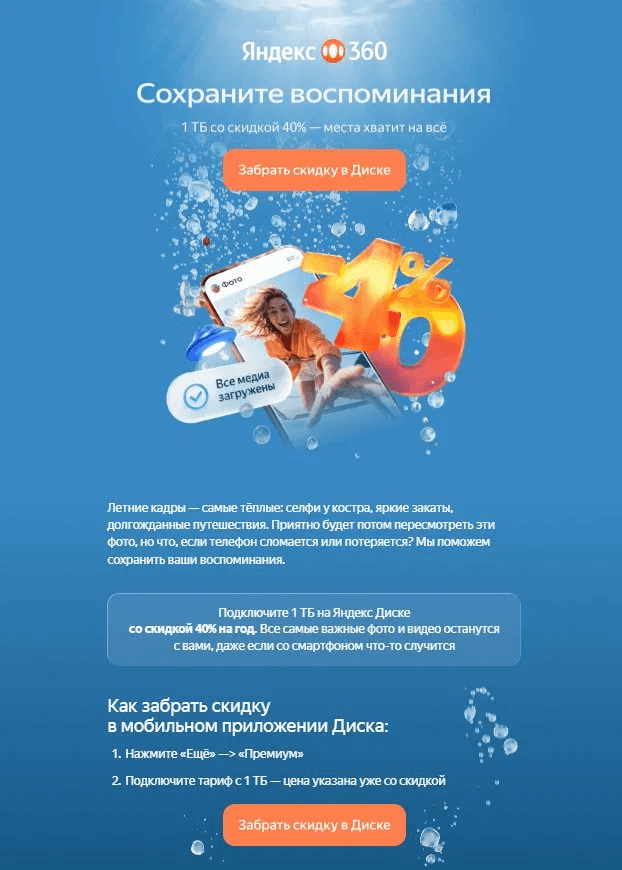
Yandex 360 explains how to activate a plan — two steps right in the email.
2. Breaking down a common mistake A specific mistake you see customers make regularly, explaining why it happens and how to avoid it. The "we see this all the time" format reads as expertise.
3. A checklist Works in any niche, as long as the topic ties to a real task the reader has. An accounting service does "closing the quarter in 12 steps," a medical clinic does "what tests to get before summer," an agency does "10 questions before launching a campaign." Checklists get saved — that's an extra touchpoint with the brand after the email's already been sent.
4. Answers to support questions Take 5–7 questions that come up most often in chat or email. Ready-made content with real demand, and it also reduces the support load.
5. A resource roundup Books, tools, templates, articles on the topic of your niche. It's fine — good, even — to include other people's content, since it shows you follow the industry. Emails like these get forwarded a lot.
6. A customer case study A real problem, a real result, specific numbers in dollars or percentages. Readers remember stories with details, and skip past vague phrases about "growth."
News and changes
Subscribers read these emails because they feel like an insider — they find out before everyone else.
7. A product or feature announcement Not a press release. A genuine story: why you built it, what changes for the user, how to try it right now. Subscribers should hear about it before site visitors do — otherwise, subscribing loses its point.

"Anton's Nearby" announces its first wave of artists — lively, with none of that press-release tone.
8. Behind the scenes How a decision about a new product gets made, why the design changed the way it did, who on the team is responsible for what. Companies that show what's happening behind the curtain come across as real — that builds trust more than any case study.
9. A period recap What you launched, what didn't work out and why — openly, without the gloss. This format works better than a highlight reel: the reader senses you're being honest with them.

IKRA School responds to audience questions and immediately answers common ones right in the email.
10. Operational changes New pricing, a schedule change, a move, updated delivery terms. It's better to let customers know by email in advance than have them discover it themselves and feel like they weren't warned.

Subscription publications announce the launch of a loyalty program and immediately explain the rules.
11. A take on a trend Not a recap of industry news, but your own opinion: what it means for your customers, how you feel about it. Companies with a point of view are memorable — companies that just mirror the news aren't.
Engagement and dialogue
12. A poll One question, two or three answer options. The poll results become the topic of the next email: "You chose X, here's why it works."
13. An open question "What's your biggest challenge right now with [topic]?" with a call to reply directly to the email. Replies give you more insight than any focus group.

Yandex asks subscribers about their experience — the button leads to a short survey.
14. A request for a review A genuine ask works better than a 1-to-10 rating: "Tell us how you use the product, it matters to us." Good answers make their way into future emails and onto the site.
15. A vote Subscribers choose the topic of the next issue, the packaging design, or the name of a new product. Someone who took part in the decision is more likely to open the email with the result.
16. A quiz 3–5 questions with a result at the end. Works well in niches with complex decisions: health, finance, education, marketing.
Personal and trigger emails
They go out automatically, but read as personal. Their open rates are higher than mass campaigns.
17. A welcome email The first email sets expectations for the whole newsletter. Say who you are, what you'll be sending, and how often. Give something useful right away — a discount, a guide, access to material.
18. A birthday email Works even without a discount. A greeting that calls someone by name and doesn't try to sell anything is rare. That's exactly why it gets noticed.
19. Reactivation An email for people who haven't opened your campaigns in 3–6 months. An honest subject line works well: "You haven't read our emails in a while, is everything okay?" Some will unsubscribe, but the rest is a genuinely engaged audience.
20. Abandoned cart or browse abandonment Remind them of the item with a photo and a direct link. "Item still in stock" is a simple subject line that works.
21. Post-purchase A day or two after the order, explain how to use the product, what to try next, how to join the loyalty program. The customer is at their most receptive to the brand right now.
Seasonal and event-based content
Gives you a natural reason to send without forcing it.
22. Preparing for the season Travel, construction, agriculture, retail, education — every niche has a busy season. An email with a "what to do before the season starts" checklist gets saved and forwarded to colleagues.
23. A professional holiday Accountants' Day, Teacher's Day, Programmer's Day. An email with real value for the right audience works better than a generic "occasion" discount.
24. A year in review What you launched, what changed, what's coming. Emails like these get opened even by inactive subscribers — a year-end recap is interesting on its own.
25. A seasonal roundup Tying it to the time of year makes a roundup feel timely. "What to read in July," "Tools for closing out the quarter," "5 recipes for the summer house season" — this works across a huge range of niches.
Selling without pressure
A sales email gets read more readily when it feels like help with a decision, not a pitch.
26. A customer story First-person storytelling: what brought them to you, what changed, what things look like now. Real details persuade better than round numbers.
27. Comparing options "When to go with the basic plan vs. the extended one" or "what's the difference between Product A and Product B." This helps the reader decide and removes one of the biggest barriers to buying.
28. An email with a deadline A discount or bonus with a specific end date. The deadline has to be real. If "today only" repeats every week, readers stop reacting to it.

MIF Publishing announces the start of a course and provides a 40% discount promo code
29. Subscribers only A private sale, early access, a price below the site's listed one. A genuine perk for subscribing.

Yandex Plus launches a promotion with cashback and prizes — available only to loyalty program members.
30. A recommendation "You bought X, check out Y." A personalized recommendation based on purchases or behavior converts better than a generic catalog. Even simple "similar products" logic delivers results.

Ozon picks products based on a subscriber's interests — three cards with prices and buttons right in the email.
How to plan content without chaos
Plan by category, not by specific topic. A month out, it's enough to decide: this email is about value, this one's about news, this one's about selling. It's easier to come up with a specific topic once the format is already set.
Keep a 70/30 ratio. 70% of emails about value, 30% about selling. If every email ends with a "buy" button, subscribers start ignoring it before they even open it.
Frequency matters less than quality. One strong email a week beats three mediocre ones. For most niches, one or two emails a week is enough.
Test your subject lines. Split your list in half and send two different subject line variants. Within a few weeks, it'll be clear which tone resonates with your audience.
Bottom line
Every company has enough material for dozens of interesting emails: the team's experience, customer questions, product changes, a take on the market. The problem usually isn't a lack of topics — it's a lack of a system.
Pick one idea from each section, and you've already got a six-week plan.
Also read: