
In 2026, grabbing attention with a subject line no longer guarantees results. Users typically skim their inbox on the go and rarely dig into the details of the text. If your open rate is within the norm but link clicks aren't happening, the problem lies in barriers within the content itself. Let's look at market benchmarks and ways to improve campaign performance.
2026 benchmark figures
To evaluate the health of your campaigns, compare your own data against market averages. These figures are based on research from Mindbox, eLama, and public Yandex case studies.
Campaign type | Average CTR (clicks) | Target CTOR* (content quality) |
|---|---|---|
Mass promos and sales | 1.5%–2.5% | 5%–8% |
Informational digests | 2.5%–4% | 8%–12% |
Triggers (abandoned cart) | 4%–7% | 15%–20% |
Welcome sequences | 8%–12% | 25%–40% |
*CTOR (Click-to-Open Rate) reflects the ratio of clicks to opens. A value below 5% indicates the email's content didn't live up to the user's expectations.
Market trend. According to Yandex case studies in HR marketing and retail, moving to narrow segmentation makes it possible to reach a CTR of 7–8%. That's the new standard for an effective campaign in 2026.
Five critical mistakes and how to fix them
1. Subject line doesn't match the content
A low click rate is often caused by unmet expectations. For example, if the subject line promises a discount on the entire range but the email limits it to one category, trust drops. In 2026, audiences instantly spot clickbait and close the message.
Solution. Think of the subject line as a promise and the email as delivering on it. If the headline states a specific benefit, the reader needs to see it right after opening the email.
2. Poor email structure
Users don't read emails carefully — they quickly scan them. If the main button is buried in the middle of a long block of text, it can get missed. The reader will lose interest in the offer before they even reach the link.
Solution. Use the inverted pyramid principle. Lead with a compelling headline, follow it with a short description, and finish with an eye-catching button. The main call to action should be visible on the first screen without scrolling.
3. Generic calls to action
Phrases like "Learn more" or "Buy" are working worse and worse, since they don't explain the value of clicking. Statistically, calls like these underperform compared to ones that spell out a specific benefit.
Solution. Write in the language of benefits. Instead of the neutral word "Find out," use "Get my training plan." Replace a generic "Go" with "Claim my 15% discount." The button should answer the user's question about exactly what they'll get after clicking.
4. Ignoring mobile users
About 80% of emails in Russia are opened on smartphones. If links are placed too close together or buttons are too small, they're hard to tap accurately. This often causes lost clicks.
Solution. Make buttons large and leave open space around them. The optimal tap target size is 44 by 44 pixels. Always check how the email displays in dark theme.
5. Technical glitches and bloated markup
Broken links or slow-loading images reduce conversion. Even with perfect copy, a technical glitch will stop someone from clicking through.
Solution. Check the email's file size before sending. If the message's code exceeds 100 KB, services like Gmail may clip it. Check every link and verify UTM tags work correctly in test sends.
A strategy for growing CTR
- Regular A/B testing. Test hypotheses in practice instead of relying on intuition. Find out what actually drives more clicks — it could be a large button near the top or a concise text link.
- Deep segmentation. Blanket campaigns to your entire list underperform compared to personal offers. Split your audience by interests or purchase history.
- Visual cues. Help users focus on what matters most. Direct their eye toward the button using graphic elements or photos.
How this works in Letteros
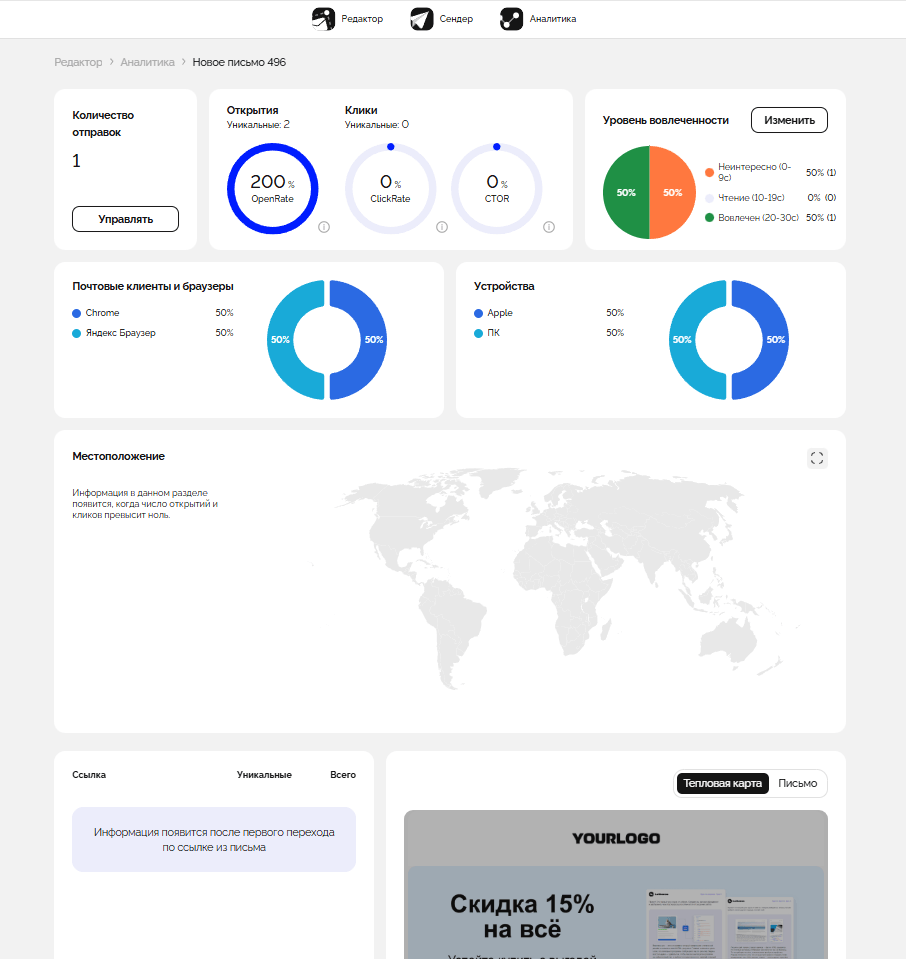
Our product automates quality auditing and helps you hit your target CTR and CTOR. Built-in analytics tools and click maps let you pinpoint exactly which elements work and where you're losing the audience's interest. This lets you quickly optimize your campaign structure based on objective data about user behavior.
