
The subject line is the only filter that determines whether a message gets read or trashed. According to research from the Nielsen Norman Group, users spend less than two seconds scanning their inbox before deciding whether to open an email. In that moment, fast-thinking mechanisms kick in (Kahneman's System 1), where the reaction to psychological triggers outpaces logical analysis.
Let's break down which mechanics influence that decision and how to use them.
Why some subject lines get opened and others don't
People decide whether to open an email on autopilot. The brain evaluates a subject line against several criteria almost simultaneously: is the sender familiar, is it clear what the email is about, is there a reason to read it right now.
A subject line passes through three filters:
The trust filter. Research shows the sender's name matters more than the subject line. If a brand is recognizable and has a clean sending reputation, that credit of trust raises the odds of an open.
The relevance filter. The brain instantly looks for an answer to "Does this concern me?" Specifics ("20% off coffee machines") pass the filter better than abstraction ("Special offer").
The urgency filter. The "now or never" psychological trigger. Without a clear reason to open the email immediately, the user puts it off — which, 90% of the time, means they never open it at all.
Psychological triggers in email marketing
1. The information gap
This mechanic is based on George Loewenstein's theory: when a person senses a gap between what they know and what they want to know, they feel discomfort that can only be resolved by getting the information.
Example: "3 email mistakes 80% of companies make."
Risk: If the email's content doesn't close the promised gap, it creates a "clickbait" effect, which drives up unsubscribes.
2. Scarcity and fear of missing out (FOMO)
According to Robert Cialdini's theory of social influence, a resource's perceived value rises when its availability is limited.
Example: "4 hours left in the sale" or "12 spots left for the intensive."
Limitation: Overusing false urgency makes subscribers immune to the trigger.
3. Social proof
People tend to copy the majority's behavior under uncertainty. Numbers and case studies in a subject line lower resistance.
Example: "3,400 marketers downloaded this checklist" or "How [Company] boosted Open Rate to 45%."
4. Contextual personalization
The classic trick of inserting a name into the subject line still works, but its effectiveness is fading. The modern standard is personalization based on user actions.
Example: "The item from your cart is back in stock" performs better than "[Name], we have news for you."
A comparison: abstraction vs. specifics
Category | Neutral subject line | Effective subject line (specific) |
|---|---|---|
Education | Marketing tips | 5 tricks that raised Open Rate by 12% |
Updates | Service news | We added the feature you asked for |
Sales | Special offer | 30% off the annual plan until Friday |
Technical parameters
Psychology won't work if the email client cuts off the headline.
Length: The optimal size is up to 40 characters for mobile devices. The key meaning should be in the first 3 words.
Preheader: This is the logical continuation of the subject line. If the subject asks a question, the preheader should hint at the answer.
Special characters: Excess emoji and all caps ("BUY NOW!!!") are a direct signal to spam filters and a marker of low-quality content.
Parameter | Professional standard |
|---|---|
Subject line length | 30–50 characters |
Preheader | 40–100 characters, complements the subject line |
Emoji | At most one, strictly on-topic |
All caps | Not recommended |
Testing as the only method of validation
Intuition is often wrong. A professional approach means always running A/B tests.
Test algorithm:
- Set aside two segments of 10–15% of your list.
- Send variant A (e.g. with a question) and variant B (with a statement).
- After 3–5 hours, determine the winner by Open Rate and send the better variant to the remaining 70% of the list.
For more on the mechanics, read our articles:
- How to Increase Open Rate Through A/B Testing Subject Lines
- The Complete Guide to Split Testing Campaigns
Streamlining the process with Letteros
Crafting effective subject lines takes time. In Letteros, this process is automated:
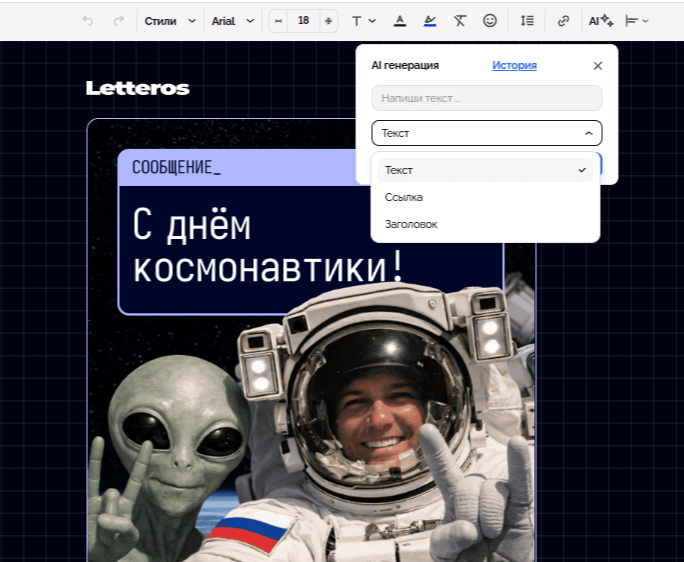
AI generation: Right in the campaign settings window, you enter a prompt or use the email's content, and AI suggests subject line options optimized for different psychological triggers. Learn how to use AI to generate subject lines.

A testing interface: Setting up a split test takes less than a minute, and results display in real time.