
ROI stands for return on investment. Applied to email marketing, it shows how much revenue each dollar invested in campaigns generates. According to DMA data, the average ROI of email marketing is around $36-42 for every dollar invested. But those are average figures, and they say little about a specific business. Let's break down how to calculate your own ROI.
The basic ROI formula
ROI = (Revenue from campaigns — Cost of campaigns) / Cost of campaigns × 100%
Example: revenue from campaigns for the month was $5,000, costs were $500.
ROI = (5,000 — 500) / 500 × 100% = 900%
This means every dollar invested brought in $9 in revenue.
What to include in costs
Email marketing costs consist of several line items.
Services and tools. An ESP subscription (email service), an email builder, analytics services, testing tools.
Team time. The work of a copywriter, designer, coder, marketer. If one person builds the email, count their hourly rate multiplied by the time spent creating it.
The cost of acquiring subscribers. Advertising to build the list, lead magnets, the cost of building subscription forms. This line item is often overlooked, even though it affects real ROI.
How to calculate revenue from campaigns
This is the hardest part. Revenue from campaigns needs to be attributed — meaning you need to understand which purchases happened because of the emails.
Direct clicks with UTM tags. The most accurate method. Every link in the email is tagged with UTM parameters, and in Yandex Metrica or Google Analytics you can see how many purchases, and for how much, were made by people who clicked through from the email.
Assisted conversions. A person received the email, visited the site, left, and returned directly three days later to make a purchase. There's no direct attribution, but the email played a role. These conversions are captured in assisted-channel reports.
Promo codes. A unique promo code for each campaign lets you accurately track purchases tied to that specific email, even if UTM tags didn't work.

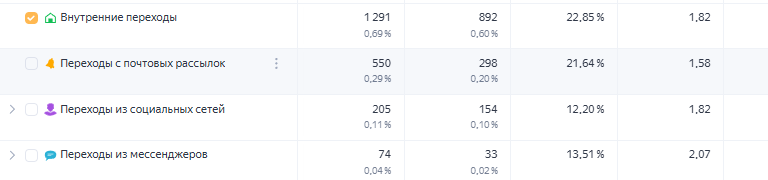
Yandex Metrica's traffic source report — the "Visits from email campaigns" row shows the number of visits and page depth. Revenue from the email channel is calculated based on this data and configured goals.
ROMI and ROAS: related metrics
ROMI (Return on Marketing Investment) — return on marketing investment. Calculated the same way as ROI, but costs only include marketing expenses, without factoring in the cost of goods.
ROAS (Return on Ad Spend) — the return on ad spend. Shows how much revenue each unit invested in advertising generated. For email this is a less relevant metric, but it's used when evaluating paid list-building.
For most email marketing needs, basic ROI and ROMI are enough.
What counts as a normal ROI
A normal ROI depends on the niche, the type of campaign, and the business model.
E-commerce with active trigger emails — ROI of 500% and up. Transactional emails (confirmations, reminders) can deliver ROI above 1000%, because costs are minimal. Content-based campaigns are harder to calculate ROI for, since their effect on sales is indirect.
If ROI is below 100%, campaigns are spending more than they bring in. That's a signal to analyze what exactly isn't working: segmentation, content, or deliverability.
Why ROI can be underestimated
There are several reasons the real ROI of email marketing ends up higher than the calculated figure.
Incomplete attribution. Some conversions influenced by an email aren't captured due to missing UTM tags, ad blockers, or switching between devices.
Impact on LTV. Campaigns retain customers and increase purchase frequency. This is a long-term effect that doesn't show up in short-term ROI.
Reduced support costs. Good informational emails reduce the number of support requests — savings that are rarely factored into the calculation.
Bottom line
Calculating email campaign ROI isn't hard once analytics with UTM tags are set up. Costs come from services and team time; revenue comes from tracked clicks and conversions. Regularly calculating ROI helps you see which campaigns are working and redirect effort to where the return is highest.
Read also: