
An email with a price list or business proposal is one of the highest-stakes formats in B2B email. It's read by people who make purchasing decisions or pass materials up to management. How clearly and persuasively the email is put together determines whether it moves to the next stage of the deal.
How a proposal email differs from a regular promo
A regular promo email is built for a fast decision. Read — click — buy.
A business proposal email runs on a different cycle. The recipient studies it, maybe forwards it to colleagues or management, compares it with other proposals. The decision doesn't happen instantly.
That means the email needs to be detailed enough to answer the main questions, but concise enough to actually get read to the end. And it needs to be easy to forward within the company.

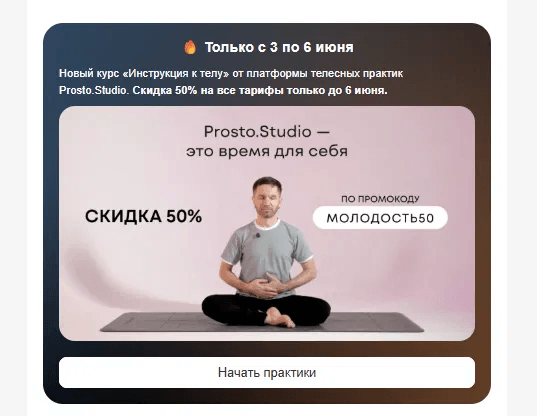
Prosto.Studio's email — a specific expiration date for the offer, the discount amount, and the promo code are all visible immediately. One button leads to the target action.
The structure of a proposal email
The subject line. It should communicate that a business proposal is inside, and name the context. "Business proposal: an email builder for a 5-person team" beats a plain "An offer for you."
The intro. One or two sentences about who's sending it and why. If the email follows a meeting or a call, mention it: "Following our conversation on June 14, we've put together a proposal."
The gist of the offer. What's being offered, to whom, and on what terms. No preamble, straight to the point. If there's a personalized calculation, it should be visible without scrolling.
What's included. A specific list of services, products, or features — what the customer gets for the stated price. Not "a full package of services," but a concrete list.
The price. It should be clear and unambiguous. If the price depends on conditions, explain the logic. A hidden price or "price on request" in a proposal email works against you.
The next step. One specific action: "Reply to this email," "Call this number," "Sign the contract via this link." Not several options — just one.
The offer's expiration date. If the offer is time-limited, state the date. This creates justified urgency without manipulation.

Prosto shows the price and terms right in the email — the old price is crossed out, the promo code is already applied, and there's a single button. The reader doesn't need to visit the site to understand the offer.
How to lay out a price list in an email
A price list in an email is a table or list with prices for specific items.
For a small price list, a table right in the body of the email works: item name, brief description, price. No more than 5–7 rows, or the email gets too long.
For a large price list, it's better to give a short selection in the email and a link to the full price list on the site or in a PDF. Don't try to cram 50 line items into an email.
If prices depend on volume or terms, show a few options with explanations. "Up to 1,000 sends — $X, up to 10,000 — $Y" reads better than a table with 20 pricing rows.

Yandex Travel shows several rates as cards — each with a specific condition and discount amount. The reader immediately sees which option fits them.
Personalization in a proposal email
A personalized proposal works better than a generic template. There are several levels of personalization.
Name and company. The bare minimum. "Hi, Maria" and mentioning the company's name in the text show the email was sent to a specific person, not blasted out to a list.
The context of the outreach. A reference to a previous conversation, request, or the customer's situation. "You mentioned you're looking for a solution for a team without a dedicated coder" — an opening like that immediately shows you were listening.
A personalized calculation. A price calculated for the customer's specific volume or task persuades better than a standard price list. Even if the calculation is simple, the fact that it's personalized builds trust.
Design and layout
A proposal email should look professional without feeling cluttered. A few principles.
Minimalist design. In B2B email, a flashy promo design with banners and illustrations performs worse than a clean email focused on text and structure. The reader came for information, not a visual experience.
A logo in the header. Builds trust and recognizability. Especially important if the email will be forwarded within the company.
Clear typography. Headings, subheadings, body text — different sizes and font weights help the reader navigate. A solid wall of text with no structure doesn't get read well.
One button, one action. Not three buttons — "Call," "Message," "Visit the site." One, for the most important action. Other contact options can be listed as text below.
What to add to build trust
Specific customer results. Not "our customers are happy," but "an 8-person team cut the time to build an email from 4 hours to 40 minutes."
Logos of well-known customers. If you have recognizable companies among your customers, a single block with their logos works better than any words.
A guarantee or refund terms. Lowers the risk for the buyer and shows confidence in the product.
A specific account manager's contact. A name, a photo, a direct phone number or email. An email from a real person builds more trust than one from "the team."
Bottom line
A proposal email works when its structure answers all the recipient's key questions — what's being offered, how much it costs, what to do next — and does it concisely. Personalization, a specific next step, and an expiration date turn the email from information into a sales tool.
Also read: