
This is a guide for marketers and content managers who want to scale up email marketing while keeping an authentic tone of voice.
Why do neural networks write so "sterile"?
When you ask ChatGPT or Claude to "write an email", you get grammatically correct but dry text. The problem isn't the algorithm's limitations — it's a lack of context. A neural network works like a mirror: it can only reflect your style if you give it clear instructions and examples.
Create a digital reference for your brand's voice
Before writing a prompt, you need to formalize the rules of the game.
1. Gather a reference dataset
Choose 10-15 emails that:
- Had the best open rate and CTR.
- Got genuine engagement from your audience.
- The team considers a perfect embodiment of your style.
2. Describe your style parameters
Fill out a table to break down your tone of voice:
Parameter | Description (choose yours) |
|---|---|
Tone | Ironic / Expert / Caring / Bold |
Rhythm | Short, clipped sentences / Smooth narrative |
Form of address | Formal "you" / Friendly "you" / By first name |
Taboos | Corporate jargon, pompous phrasing, specific trigger words |
Humor | Subtle sarcasm / Wordplay / No humor |
Write a system prompt for your style's DNA
A system prompt is the base instruction that governs the AI's behavior across all subsequent conversations.
An example prompt you can copy:
Role: You are the lead copywriter for [Company Name]. Your job is to create copy that mimics a genuine conversation and builds trust, rather than broadcasting advertising slogans.
Brand voice (Tone of Voice):
Style: Concise, professional, with a moderate amount of irony.
Rhythm: Vary sentence length. Avoid participial phrases and heavy constructions.
Vocabulary: Use markers characteristic of us: [for example: "perk", "payoff", "honestly"].
Constraints (negative constraints):
Banned words: Exclude clichés like "unique", "innovative", "best", "market leader".
Grammar: No passive voice. Instead of "it was implemented by us", use "we implemented".
Clutter: Remove filler phrases ("by the way", "of course", "it's important to note").
Message structure:
- Headline: A short question or an intriguing statement.
- Main body: A short case study, personal experience, or a solution to a specific customer pain point.
- Call to action (CTA): One target action with no pressure on the reader.
Use the learn-from-examples method
Neural networks learn best from examples. The few-shot method is when you give the model samples before setting the main task.
A prompt template:
"Below are 3 examples of our best campaigns. Analyze their structure, vocabulary, and emotional tone:
Example 1: [Text]
Example 2: [Text]
Example 3: [Text]
Based on this style, write a webinar announcement on the topic [Topic]".
Fine-tune accuracy through feedback
The first result is a hypothesis. Don't expect perfection right away — use targeted edits:
❌ Bad: "Too formal, redo it".✅ Good: "Tone down the seriousness. Replace formal terms with marketer slang. Add one joke about deadlines to the P.S. at the top".
If the neural network nailed the tone in one paragraph, tell it: "Paragraph #2 is the reference. Rewrite the rest of the text in the same key".
Advanced methods (for pros)
Knowledge base integration
Professional interfaces (like Claude Projects) let you upload external data. Upload a PDF with your brand book or editorial guidelines: the neural network will automatically cross-check the company's rules on every generation, saving you from repeating instructions.
Model fine-tuning
If you have archives of thousands of emails at your disposal, it makes sense to fine-tune a model via the API. Unlike ordinary instructions, this method embeds the desired speech patterns at the level of the model's responses. The algorithm starts using vocabulary and structure characteristic of your brand by default, minimizing the amount of manual editing needed.
Common mistakes
Abstract requirements
A neural network can't interpret subjective adjectives like "creative", "vivid", or "punchy". It needs clear parameters. Instead of "write it interestingly", set a specific mechanic: "use culinary metaphors" or "build the text from short, clipped sentences in Hemingway's style".
Skipping the final edit
Even the best-tuned model is prone to hallucinations and stylistic repetition. AI handles the rough draft and idea generation, but controlling the facts and shaping the final key points remains the editor's job. Without a human filter, the text stays mechanical.
Automating the process in Letteros
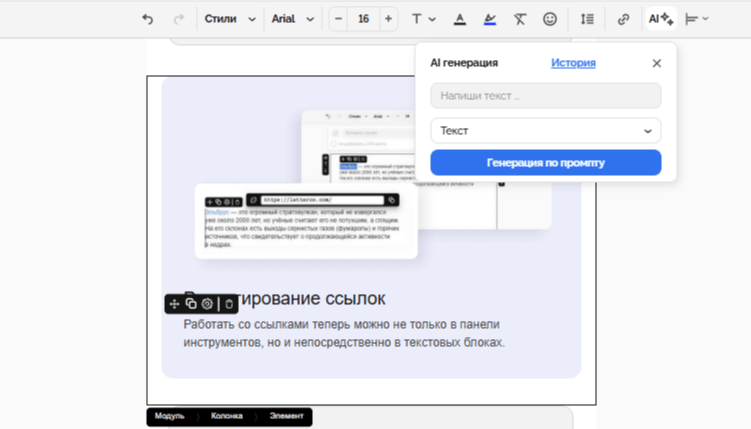
In Letteros, a neural network specifically trained for email content is already built in. It helps you:
- Generate catchy subject lines and preheaders.
- Adapt the text to your tone of voice right in the editor.
- Suggest CTA variants that actually convert.
This saves you hours of routine work, letting you focus on strategy instead of staring down a blank page.
