
AI is already built into most popular email platforms. At best, marketers use it to generate subject lines and miss out on dozens of other use cases. Let's break down where neural networks deliver measurable results — and where it's better to leave them alone.
Segmenting your list without a CRM
Classic segmentation splits subscribers by gender, city, and subscription date. AI analyzes behavior: which emails they opened, what they clicked, what time they read at, and how long ago they last engaged.
Based on this data, it automatically identifies groups that would be hard to even come up with manually. For example, "reads but doesn't click," "only clicks on discounts," or "opens emails late at night on mobile."
Tools with built-in AI segmentation: Mailchimp (Predicted Demographics), HubSpot, and Unisender via API integration.
Personalizing email content
Personalization isn't just "Hi, Ivan" at the top of an email. AI dynamically tailors the content for each specific recipient.
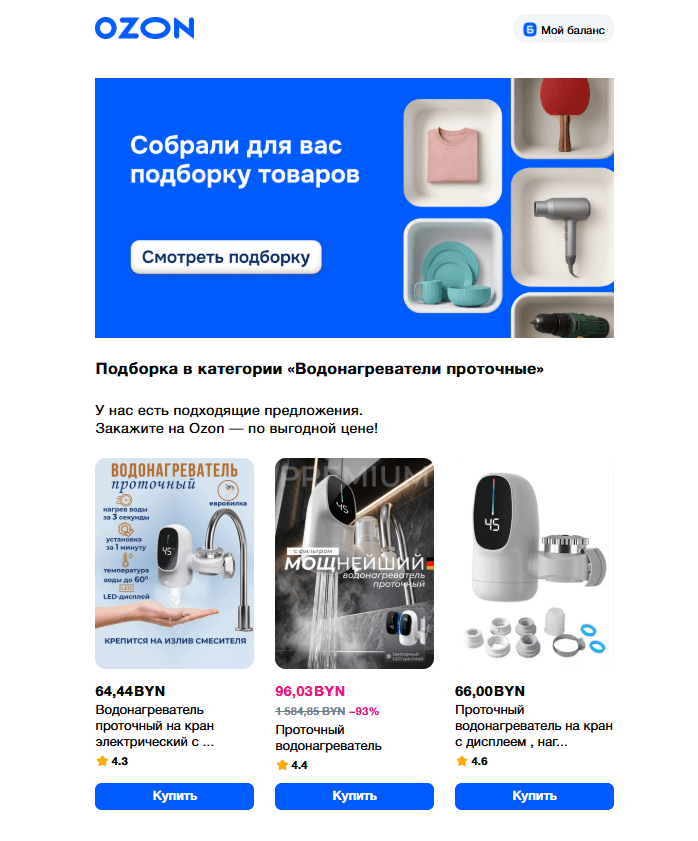
An online store sends a single email, but each subscriber sees different products in it — the ones they're most likely to buy. The content is populated the moment the email is opened, based on purchase and browsing history.

Ozon builds a selection based on the categories a subscriber browsed — each person gets an email with their own set of products.
Predicting churn and reactivation
AI predicts which subscribers are about to leave before they click the unsubscribe button. Warning signs include declining open frequency, shorter reading time, and no clicks in the last 60–90 days.
A reactivation sequence can be launched ahead of time — while the subscriber is still warm. Conversion in this case is noticeably higher than when working with an already "dead" audience.
This approach is implemented in Klaviyo and Mindbox through predictive analytics.
Optimizing send time
Most companies send emails at the same time to their entire list — usually Tuesday through Thursday, between 10 and 12. AI analyzes when each individual subscriber opens their inbox and sends the email at their personal activity peak.
This feature is called Send Time Optimization (STO). It's available in Mailchimp, Brevo, and Klaviyo. According to these platforms, personalized send times increase Open Rate by an average of 10–15%.
Lead scoring within your list
AI assigns each contact a score based on behavior: open frequency, clicks, purchases, and time on the list.
This lets you work with your list more precisely: guide "hot" contacts toward a purchase, warm up "warm" ones with content, and leave "cold" ones alone to avoid hurting your domain reputation.
Analyzing campaign performance
AI doesn't just collect statistics — it interprets them. It finds patterns that are hard to spot manually: that subscribers in a particular segment click emails with minimalist design twice as often as emails with banners. Or that, specifically for your audience, a question-based subject line performs worse than a statement.
Analytics that would take an analyst several hours to compile, AI generates automatically after every campaign.

Mailchimp Predicted Demographics — AI determines your list's demographics without surveys and lets you immediately target the right segment.
Automatic A/B testing
A classic A/B test compares two variants and waits for statistical significance — usually several days. AI tests multiple variants simultaneously, automatically identifies the winner, and switches the remaining audience to it.
For urgent campaigns with a tight deadline, this is the only way to test something before the promotion ends.
List cleaning and validation
AI tools identify not just addresses with syntax errors but potentially risky ones too: temporary mailboxes, spam traps, and addresses with zero activity over the past six months.
Regular cleaning has a direct impact on domain reputation and deliverability. Some ESPs already build validation right into the list upload interface.
Where AI won't replace a person
Brand voice. An email written by a neural network without editing comes across as neutral and impersonal. It can be used as a draft, but the final copy needs to go through a person.
Crisis communications. A scandal, a technical outage, a force majeure event — a person needs to write to customers. AI doesn't sense context and can easily strike the wrong tone.
Unconventional campaigns. Special projects, collaborations, holiday campaigns with an unusual concept — a neural network gives you a templated result. An original idea is born from a person.
The bottom line
AI is useful wherever a task is repetitive and measurable: segmentation, send timing, list cleaning, initial results analysis. An algorithm does all of this faster and more precisely.
The meaning, tone, and idea behind any specific email remain a person's job.
Read also: