
In online education, email solves one problem that no other channel solves: getting students to finish the course. The average online course completion rate is 10–15%. Email communication helps raise it two to three times over.
Let's walk through every stage of a student's journey with the school and what to write at each one.
Stage 1. Sign-up and pre-registration
A person left their email, but the course hasn't started yet. The job of these emails is to keep up interest and prevent them from "cooling off" before the start.
- Email right after signing up. Confirmation plus a specific start date, what to prepare, and who to contact with questions
- Email one week before the start. A reminder, a short preview of the program, and what's needed for the first class
- Email the day before the start. Instructions on how to log into the account, a link, and a time reminder
Pre-start emails reduce the number of "lost" students — people who signed up but didn't log in on day one.
Stage 2. Course onboarding (first week)
The first week determines whether a student will make it to the end. If they haven't completed a single assignment in the first three days, the odds of finishing the course drop sharply.
- Welcome email on day 1. Not the school's history — one first step: log into the account and watch the first lesson
- Email on day 2–3. A reminder if they haven't opened the first lesson. "We noticed you haven't started yet — can we help?" Answer buttons right in the email
- Email on day 5–7. For those who've started: the next step and motivation. For those who haven't: a gentle email with a question
Stage 3. Support during the course
This is the longest stage and the hardest to balance — you need to remind students about the course without turning into spam.
Behavior-based trigger emails
- Student hasn't opened the platform in 5 days — a reminder about the specific assignment they missed
- Student completed an assignment — congratulations and a preview of the next lesson
- Student watched the lesson but didn't submit the assignment — an email with a hint or an offer to help
Scheduled emails
- Weekly progress digest. "This week you completed X lessons, Y left to go"
- Email at the midpoint of the course. This is a critical point — many people drop out right here. Remind them why they started, and show them they've already passed the halfway mark

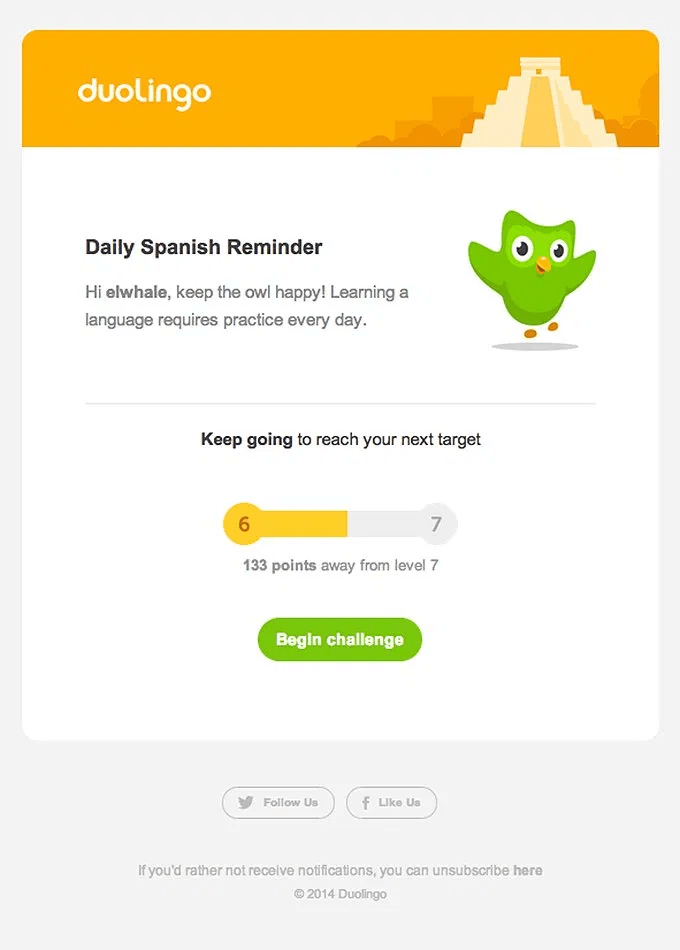
Duolingo shows progress visually — a progress bar between levels and a specific number of what's left. One "Begin challenge" button leads straight to the next step
Stage 4. The final stretch and completion
When there are one or two weeks left until the finish line, students split into those who'll make it and those who start dropping off. Emails at this stage need to work for both groups.
- For active students. A preview of the final assignment, the criteria for getting a certificate, and what to expect after finishing
- For those falling behind. An email offering to extend access or reschedule the submission without losing progress
- Email after receiving the certificate. Congratulations — not templated, but mentioning the specific course. An invitation to share their success and links to the next level
Stage 5. After the course
A student who made it to the end is the warmest contact in your list. They already trust the school and got a result.
- Review request 7–14 days after finishing. Not on the day of the certificate — give them time to apply what they learned
- Preview of the next course. 3–4 weeks later, once the initial excitement has settled but the results are still fresh
- Email 3 months later. "How are you applying what you learned?" — this is both feedback for the school and a reason to reconnect
What matters technically
Every email in the sequence should look like a single, unified communication from the school — a consistent style, a recognizable tone. A student receives dozens of emails over the course, and if each one looks different, it feels chaotic.
In Letteros, the master template is set up once, and every email — from the welcome message to the diploma congratulations — is built on top of it.
More on welcome sequences: letteros.com/blog/marketing/welcome-email-guide/
More on trigger emails: letteros.com/blog/marketing/50-uspeshnyh-triggernyh-rassylok/