
In the B2B segment, email campaigns deliver results when they account for the specifics of business communication and the long deal cycle. Unlike mass-market sales, here email serves as a tool for building trust and confirming your expertise.
Let's break down the differences between B2B and B2C and use examples to show how to turn email into a sales channel.
B2B vs. B2C differences in email marketing
The difference between these spheres lies in buyer psychology and how decisions are made. In B2C you're addressing a person who is spending their own money for personal enjoyment. In B2B the recipient is an employee who manages the company's budget and is accountable to management.
Parameter | B2B (Business to Business) | B2C (Business to Consumer) |
|---|---|---|
Deal cycle | Long (from weeks to a year). One email doesn't sell. A series of touchpoints is needed to warm up the lead. | Short (from minutes to days). The path from email to payment takes one click. |
Decision-making | A group of people (decision-makers). The interests of technical staff, finance people, and directors are all taken into account. | One person. The decision is made personally or under family influence. |
Logic and incentives | Rationality. ROI, safety, and process efficiency matter most. | Emotions. Discounts, status, comfort, and instant gratification matter most. |
Database and risks | A narrow database, expensive contacts. A mistake in a single email can cost a multimillion-dollar contract. | Mass reach. Mistakes aren't as critical given the huge size of the database. |
Content | Expertise and case studies. Copy is built on numbers, facts, and real-world examples. | Visuals and offers. The focus is on design, product photos, and time-limited promotions. |
Sending schedule | 1–2 times a week. Only on workdays, when the recipient is focused on tasks. | 3–5 times a week. Including evenings and weekends. |
Call to action (CTA) | Soft. “Book a demo”, “Get a quote”, “Download the report”. | Aggressive. “Buy now”, “Grab the discount”, “Add to cart”. |
What types of emails work in B2B
For the email channel to deliver results, the content needs to smoothly guide the client through the stages of the sales funnel.
Expert content and market analytics
Businesses trust professionals. Research findings or an in-depth look at industry trends confirm your expertise. This isn't a direct sale — it's a reason to start a conversation.
- What to send: market overviews, analytical reports, forecasts for your industry.
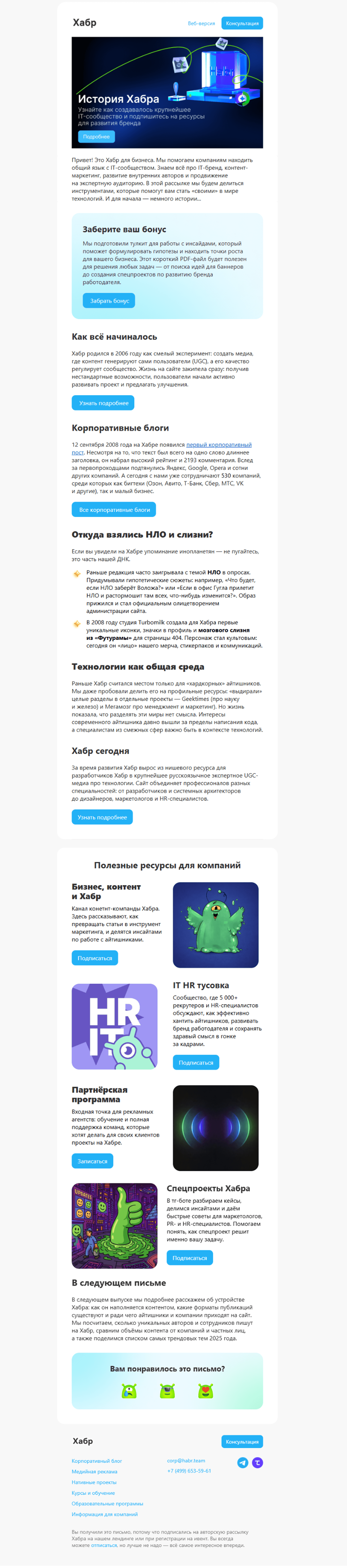
Example No. 1. Expert content digest
Habr's newsletter for business partners. The company doesn't sell services outright — instead, it shares the platform's story, case studies, and useful links for HR departments. This builds the image of an expert environment that business clients want to be part of.

Practical value and tools
Emails that provide instant value build loyalty. These are materials the recipient can apply at work right after reading.
- What to send: sample technical specifications, vendor evaluation checklists, ROI calculators.
Example No. 2. Email with a useful tool
Bitrix24's newsletter with an implementation guide. A clear promise of value in the subject line, a minimal description, and a prominent download button above the fold. This kind of email solves an acute customer pain point and confirms the service's expertise.

Event invitations
Webinars and conferences help move from reading emails to personal communication. In the email, emphasize the skills the participant will gain, not the speaker's credentials.
- What to send: announcements of online seminars, invitations to business breakfasts or conferences.
Example No. 3. Invitation to an educational program
An email from WE Platform. Instead of self-promotion — a list of skills the training will provide. The copy has clear deadlines and an understandable call to action. This matters to a business audience that values time and specifics.

Follow-up emails
Messages that record the outcomes of meetings or calls. They're essential for managing complex sales. The email should contain a brief summary of the conversation and a list of next steps.
Structure of the ideal follow-up:
- Subject: project name or meeting date.
- Summary: a brief, bullet-point account of what was discussed and which tasks were identified.
- Action plan: a list of tasks with deadlines (who does what and when).
- Materials: a link to the presentation, the call recording, or the promised case study.
Common B2B email mistakes
- Copying mass-market style. Capital letters and manipulative countdown timers don't work in business-to-business communication. They irritate professionals.
- Bureaucratic language and a dry, formal tone. An email shouldn't read like a contract. Write simply and clearly, respect the recipient's boundaries, but don't turn the text into a dull report.
- A single call to buy. If the client is still just exploring the problem, an offer to purchase immediately is premature. Offer to learn more or see the results of similar projects.
- No segmentation by role. Sending a technical specification to a CFO is pointless. The message should match the recipient's area of responsibility.
Breakdown of a B2B digest from Letteros
Using our own email as an example, let's look at how expert content helps retain customers and develop the product.

You can view the web version of the email here
This is a classic B2B format for those already familiar with the service. The email gently reminds recipients about the platform and clearly shows how the product is evolving.
The email is divided into topics: “Editor and design”, “Functionality”, and “Platform updates”. This way the reader doesn't waste time on irrelevant content and goes straight to the news that matters to them. We present every update through its real-world benefit. We don't just write about technical tweaks — we explain that now you can manage email adaptation directly in the editor without third-party services. In business communication, this kind of language is valued above all, because it saves the client's resources.
Instead of one general button at the end of the email, we use targeted calls to action. Buttons like “Go to editor”, “Book a demo”, or “Watch the lesson” are placed exactly where the user's interest arises. And the block with articles in the footer creates an additional touchpoint for those who just want to read useful material for now and stay connected with the brand.
Technological features of B2B communications
In B2B, you need to get past the spam filters of large companies (banks, factories, state corporations).
1. Domain authentication
So that the client's server (for example, @sberbank.ru) doesn't block the email on arrival, your domain needs SPF, DKIM, and DMARC configured. This confirms to mail services that the email really came from you, not a scammer. Without these settings, deliverability to large corporations will be minimal.
2. A strategy for each funnel stage
- Stage 1: Awareness. The client becomes aware of the problem. We send educational articles, analytics, and digests.
- Stage 2: Consideration. The client is looking for a tool. We send technical comparisons, feature overviews, and webinar invitations.
- Stage 3: Decision-making. Finalizing the deal. ROI calculations, detailed case studies, and RFP templates are needed. Checklists and instructions play a decisive role here.
How Letteros helps build B2B email campaigns
The platform Letteros helps companies get their email in order and forget about layout issues. Our key solution is a branded master template. This is a ready-made builder with your fonts, colors, and logos already configured.
For B2B, this is a great way to establish a regular workflow. You no longer need to bring in a designer or a coder for every campaign. You simply assemble a report, digest, or business proposal from ready-made blocks in 20 minutes. The layout automatically adapts to smartphones and dark mode, so your messages always look professional.