
The channel is still part of the strategy for 78% of marketers (Salesforce, 2026), and companies that work with it systematically get one of the most predictable growth channels around. Approaches that worked five years ago now hurt deliverability and damage your domain's reputation.
We break down six shifts defining email marketing in 2026.
1. Mass blasts are out. Personalization is in
Sending one email to your entire list and seeing what happens breaks down at the algorithm level. In 2026, mail providers evaluate each recipient's engagement individually. If a significant chunk of your list ignores your emails, the algorithm starts routing them to spam — including for people who normally read them.
The critical complaint threshold is 0.1%. With mass, unsegmented sends, you blow past it fast.
The numbers back this up: 57% of marketers already personalize content based on behavior, purchase history, and engagement level (Salesforce, 2026). More than 90% of marketers who use segmentation report improved newsletter metrics (Litmus, State of Email 2025).
In 2026, personalization isn't just a name in the greeting. It's:
Different sequences for newcomers and loyal customers. Different content for people who've bought something versus people who've just been browsing. Different frequency for active subscribers versus ones who are drifting away.
For more on how to segment your list, see the article How to Segment Your Subscriber List Without a CRM.

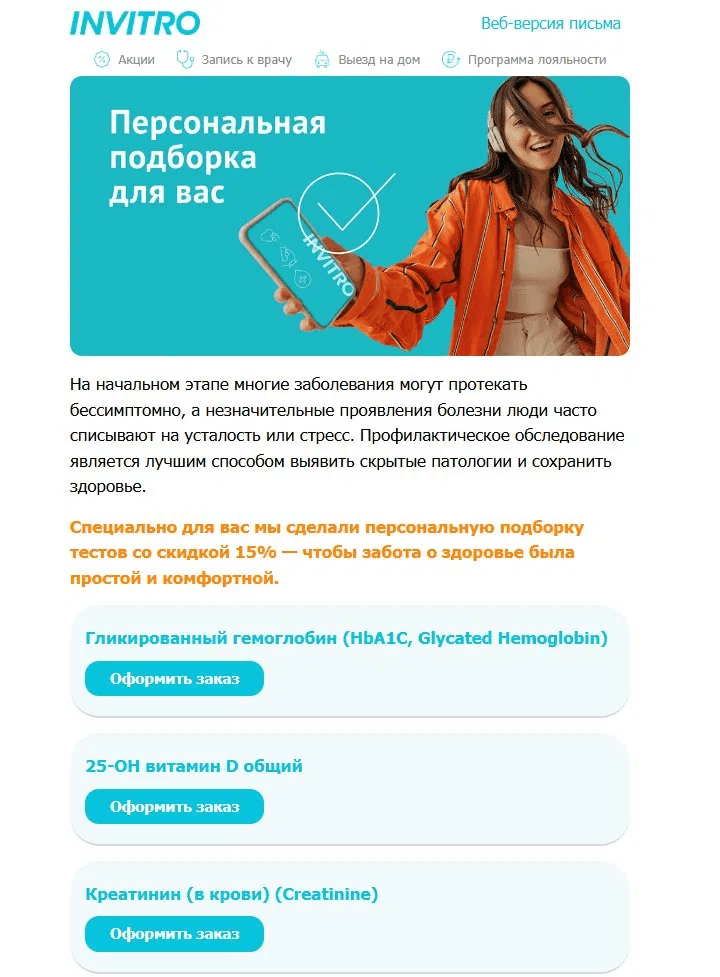
INVITRO's "A Personal Selection for You" email is a great example — a personal offer, relevant products, and a specific discount, all clearly visible.
2. Bloated coding is out. Optimization is in
Heavy emails with dozens of blocks, embedded fonts, uncompressed images, and duplicated CSS aren't just an aesthetic problem. Gmail clips emails heavier than 102 KB. Some readers will never see your main offer because it's hidden behind a "View entire message" button.
The trend is moving toward minimalism: one goal per email, one call to action above the fold, a structure you can scan in a second. According to Litmus, teams that used to spend two weeks building a single email now do it in a few days in 2026, thanks in part to modular templates.

A Lamoda email is a good example of dense layout with multiple banners and competing CTAs.
For more on speeding up newsletter creation with a system of ready-made modules, see the article How to Speed Up Email Creation with Master Templates.
3. One-off campaigns are out. Automation is in
Manually scheduling and sending emails is a strategy that doesn't scale. While a marketer is putting together the next digest, a competitor is automatically sending an email the moment a user abandons their cart, doesn't finish onboarding, or hasn't opened an email in 60 days.
Automated emails consistently outperform manual campaigns on open rate and conversion, because they arrive at the right moment — in response to a real user action. By 2026, 89% of marketers expect up to 75% of email strategy operations to be fully automated with AI (Litmus).
Getting started is easier than it sounds. Three scenarios you set up once and that keep running:
A welcome email after sign-up. A reminder about an abandoned cart. Reactivation after 60 days of silence.
For which scenarios to start with, see the article Where to Start With Email Automation.
4. Open Rate is out as the top metric. Focus on clicks is in
15% of marketers still use Open Rate as their main KPI, even though Apple Mail Privacy Protection made it unreliable back in 2021 (Litmus, State of Email 2025). Apple Mail preloads tracking pixels through its own servers without waiting for the email to actually be opened. As a result, some "opens" are just a technical artifact, not a real reader.
The market is shifting to more reliable metrics:
CTR — unique clicks. CTOR — clicks relative to opens. Post-click conversion. RPE — revenue per email.
These are the metrics that reflect real engagement and directly affect your domain's reputation with providers.

Newsletter analytics in Letteros — focus on clicks and engagement level, not just opens
For more on key metrics, see the article Key Email Marketing Metrics.
5. Dependence on social media is out. Your email list becomes an asset
Social media algorithms show posts to 2–10% of your audience organically. If a platform changes its rules or blocks your account, your reach disappears overnight. Your email list belongs to you. It isn't handed over to any platform, and no algorithm decides who gets your email.
But list quality matters more than size. According to AWeber (2026), 43% of small businesses have a list of up to 500 subscribers, and only 20% of them consider their strategy effective. With over 500 engaged subscribers, effectiveness is twice as high.
A list of 300 people who trust you will beat a list of 3,000 random contacts.
For how to grow your list the right way, see the article How to Grow Your Subscriber List Organically.
6. One-off content is out. Newsletters become a retention tool
58% of marketers include newsletters in their strategy, up from 46% in 2024 (Litmus, State of Email 2025). The reason is simple: only about 5% of the audience is ready to buy right now. A newsletter keeps the connection alive with the other 95% until they're ready.
A regular newsletter does three things that are hard to achieve with other tools:
Builds trust through consistent contact. Demonstrates expertise without a hard sell. Stays top of mind for the reader at the moment they're making a decision.
A brand that sends a useful email every week is competing on completely different terms than one that only ever writes about promotions.

Skyeng's content newsletter puts useful material first and the offer second. That's how trust gets built before the moment of purchase
For what to write in a corporate digest, see the article What to Write in a Corporate Digest.
Three shifts that work as a system
Personalization, coding optimization, and automation aren't three separate tasks.
Personalization without automation doesn't scale: manually sending different emails to different segments every week just isn't possible. Automation without optimized coding produces inconsistent results: emails fall apart in Outlook or get clipped in Gmail. Optimized coding without personalization is a beautiful email that still gets ignored.
Companies that built out this system before everyone else are, in 2026, getting a channel with 95–98% deliverability and engagement rates several times above the market average.
Also read: