
Segmentation solves the same task in both cases — sending the right email to the right person. But the logic used to divide the audience is fundamentally different. In B2C, segmentation is based on behavior and personal characteristics. In B2B, it's based on a person's role in the company, their industry, and the deal stage.
How segmentation works in B2C
In B2C, the audience is large, and purchase decisions are made quickly and often emotionally. Segmentation is built around who the person is and what they do.
By demographics. Age, gender, city, marital status. A children's products online store segments by the child's age. A jewelry brand segments by gender and marital status. This is the basic level, giving a rough division.
By behavior. What they viewed, added to cart, purchased, how recently they were active. This is the most effective type of segmentation for e-commerce. A person who has been looking at sneakers for three days in a row and a person who bought them yesterday should receive different emails.
By lifecycle stage. New subscriber, first-time buyer, repeat customer, "dormant" — each has its own communication goal. New subscribers need to understand the brand's value, repeat customers need their loyalty rewarded, dormant ones need a reminder.
By interests and preferences. What they chose, which categories they clicked on, what they read in the newsletter. This type of segmentation lets you show relevant products and content without complex CRM setups.

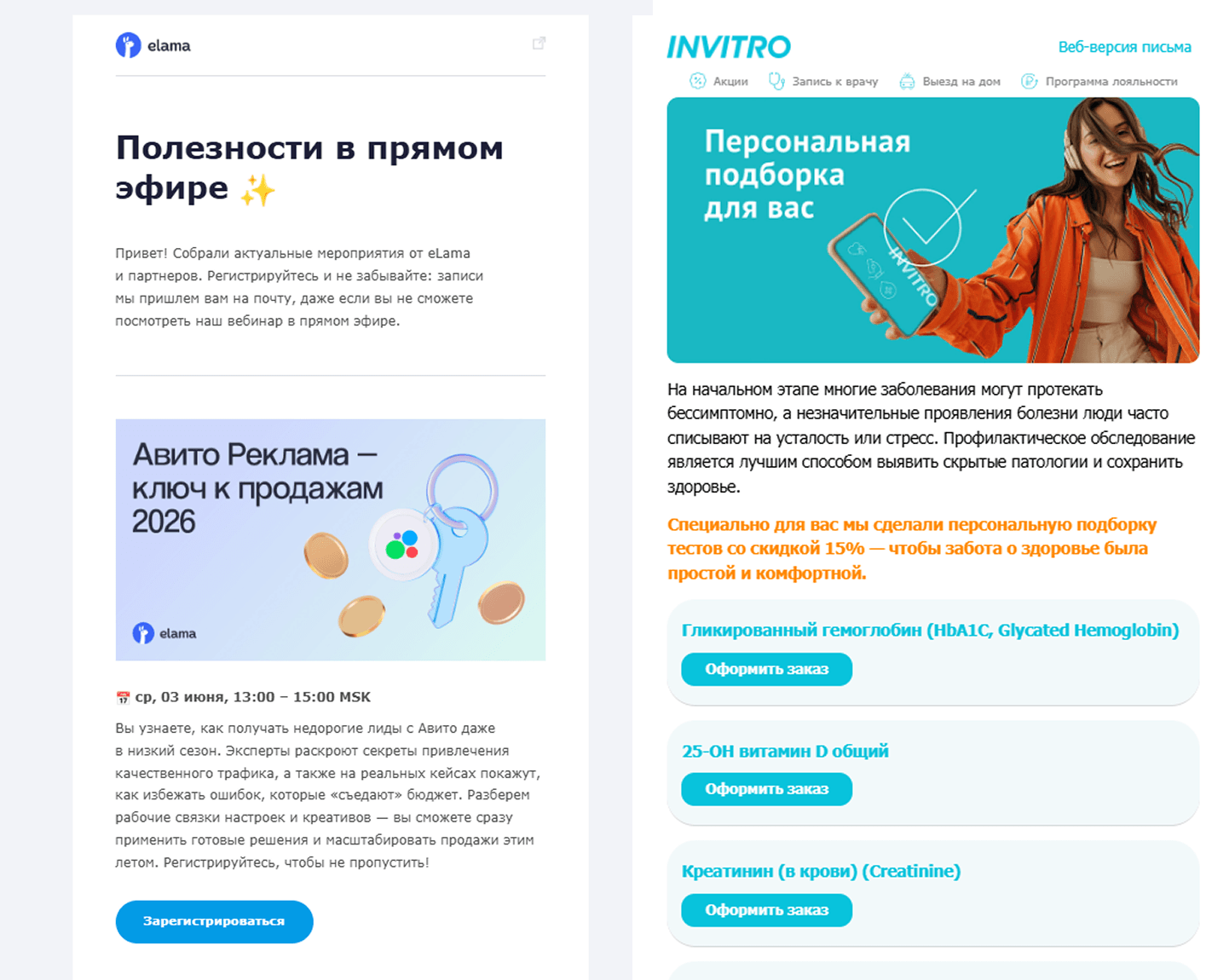
The B2C email from INVITRO features bright design, a personal selection, and emotional copy. The B2B email from eLama has a business tone, a specific subject, and a single button. Different logic, different language, different goal.
How segmentation works in B2B
In B2B, the deal cycle is longer, and the decision is made not by one person but by several. An email to a CFO and an email to a marketer at the same company should be different — they have different tasks and different selection criteria.
By position and role. A top executive thinks about ROI and risks. A technical specialist thinks about integrations and reliability. A marketer thinks about convenience and functionality. The same product needs to be explained differently to each of them.
By industry. Manufacturing, retail, finance, healthcare — each industry has its own specifics, pain points, and language. An email with retail examples won't resonate with someone from a manufacturing company.
By company size. Small businesses and large corporate clients buy differently. For small businesses, price and simplicity matter. For corporations, security, integrations, and support matter.
By deal stage. This is the key type of segmentation for B2B. A lead who has just learned about the product isn't ready for a commercial proposal. A client at the contract approval stage doesn't need educational content. Each stage requires its own type of email.
Key differences in practice
Number of contacts in the deal. In B2C, an email goes to one person who makes the decision themselves. In B2B, a single company may have several contacts with different roles. You need to segment not only by company, but also by position within it.
Speed of decision-making. In B2C, only a few hours may pass from first contact to purchase. In B2B, it can take several months. This means B2B email sequences are longer, and the content at each stage is different.
Sending triggers. In B2C, triggers are behavioral: viewed a product, added it to cart, made a purchase. In B2B, triggers are tied to the deal stage: registered for a webinar, downloaded a guide, requested a demo, missed a call.
Tone and content. B2C emails can be emotional, short, with bright images. B2B emails are more often informative, with specific numbers, case studies, and justification of business value.

The B2C email from Yandex Afisha features bright design, a promo code, and emotion. The B2B email from eLama features a concrete list of features, a business tone, and a button to the personal account. Different audiences require different approaches.
General principles that work in both cases
Despite the differences, there are a few universal rules.
Segmentation needs to be updated. Subscriber behavior and status change. A customer who was active six months ago might now be "dormant." Segments need to be reviewed regularly, not set up once and forgotten.
It's better to start small. You don't need to build a complex segment matrix from day one. In B2C, it's enough to start by dividing by activity: whether they open emails or not. In B2B — by deal stage. The rest gets added as data accumulates.
Personalization only works with quality data. An incorrectly inserted name or an irrelevant product recommendation is worse than no personalization at all. Before launching segmented sequences, it's worth checking the quality of the data in your database.
Bottom line
B2C segmentation is built around behavior and personal characteristics, while B2B is built around role, industry, and deal stage. The tools are similar, but the logic is different. Understanding this difference helps you avoid copying B2C approaches into B2B and vice versa — ultimately resulting in emails that get read and get responses.
Also read: