
Most online stores send campaigns following the same pattern: promo, promo, promo. A subscriber gets a discount email, ignores it, gets another one a week later, and ignores that too. Open rate drops, the list burns out, and the marketer offers an even bigger discount.
The problem isn't that emails aren't needed. The problem is that only one of the five email types that actually move revenue is being sent.
Below is a breakdown of each type: why it matters, how it's structured, and exactly what to write.
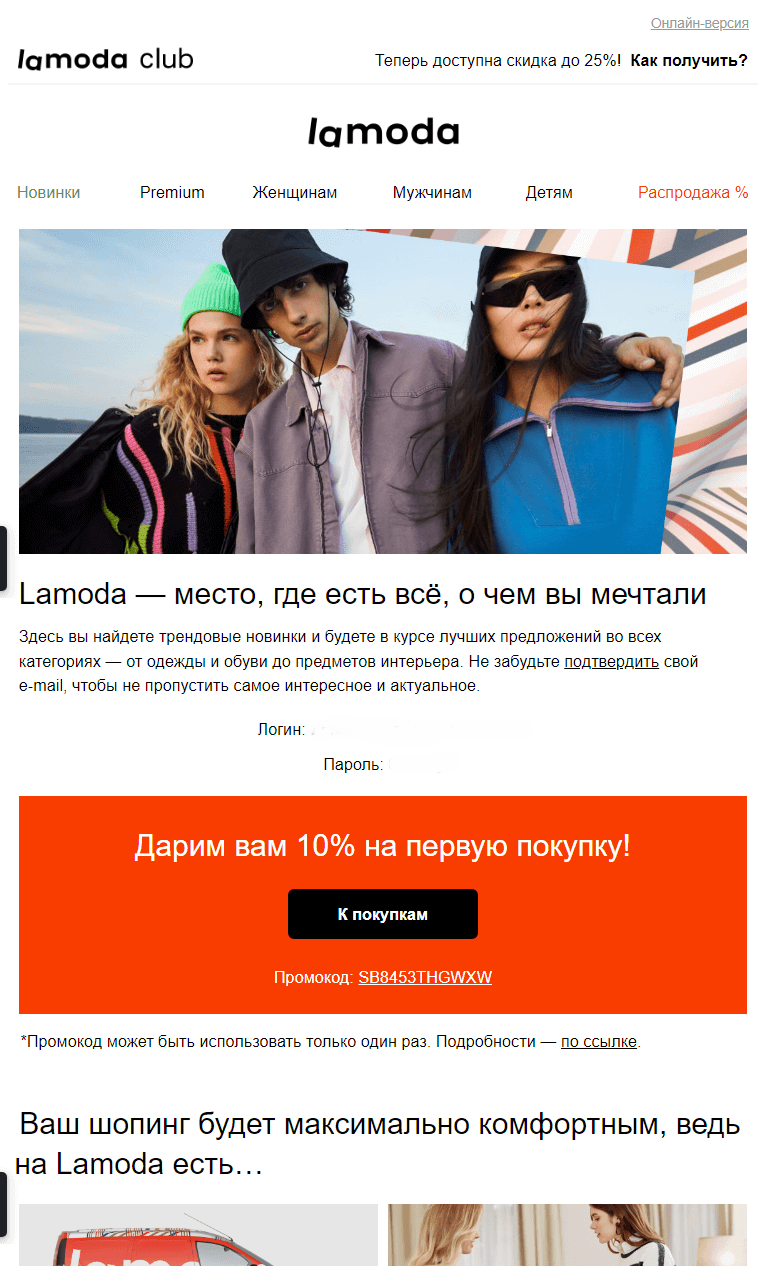
1. Welcome email — a first impression you don't get to redo
The subscriber just left their email address. They're warm — they've just picked something out, gotten interested, and trusted you with their address. This is the best moment for contact in the entire relationship cycle.
The average open rate for a welcome email is 50–60%, compared to 15–25% for a typical promo campaign. People open the email they're expecting.
What a welcome email should include:
Subscription confirmation. "You're in, all good." Short, no corporate-speak.
A promise of value. What the person will get: discounts, exclusive deals, useful content. Be specific, not "the best offers."
A call to action. Browse the catalog, check out new arrivals, grab the lead magnet promised on the signup form, if there was one.

What not to do: don't dump the entire catalog on them, don't write "Welcome to our big family," don't make the email longer than two screens.
Read more about welcome emails in our article
2. Abandoned cart email — the most obvious way to recover revenue
70–80% of users add an item to their cart and leave. Some got distracted, some were comparing prices, some had doubts. An abandoned cart email is a reminder at just the right moment.
According to Klaviyo, the average revenue per abandoned cart email is around $5.81. It's the highest-converting trigger in e-commerce.
Series structure:
After 1 hour — a gentle reminder. "You left something behind." No pressure, no discount.
After 24 hours — reinforcement. Show the item larger, add social proof: reviews, ratings, "X people are looking at this item right now."
After 72 hours — the final touch. Here you can add a discount or free shipping if it's justified by margin.
What works in the subject line: "You forgot something important," "[Product name] is still waiting for you," "Only 3 left" if stock is genuinely low, "Your cart misses you" — works for youth brands, doesn't work in B2B.
The biggest mistake — writing "You didn't complete your purchase" in the subject line. It sounds like an accusation, not an invitation to come back.

3. Post-purchase email — the moment everyone misses
The person just bought something. They're satisfied, they trust the store — it's the peak of loyalty. Most stores send a dry "Your order #12345 has been placed" at this point and leave it at that.
A transactional email is necessary. But beyond it, there's room for emails that build the relationship and set up the next purchase.
Post-purchase sequence:
Order confirmation — right after payment. Order number, contents, delivery timeline. Clear, no embellishments.
"How's your order going?" — 3–5 days after delivery. Check that everything's fine, offer help.
Review request — 7–14 days later. The more honest and short the ask, the higher the review conversion.
Upsell email — 2–4 weeks later. Products that complement what was bought. Not "check out our catalog," but a specific selection.

The review request email isn't just about UGC. It signals to the subscriber that the store cares. Even if the person doesn't leave a review, the email still builds loyalty.
4. Re-engagement email — how to work with a dormant list
Part of your list stops opening emails. That's normal. People's interests change, they switch to other channels, or they simply forget why they subscribed.
Continuing to send emails to a dormant list damages your domain's reputation. Gmail and other providers track the share of users who ignore a campaign, and start routing it to spam — first for the dormant segment, then for everyone.
A re-engagement campaign solves two problems: it wins back the people who can still be won back, and it helps cleanly unsubscribe the people who can't.
Series structure:
First email. "We noticed it's been a while." Remind them of the value of your emails. No pressure.
Second email. Offer something concrete. A discount, an exclusive deal, a selection tailored to their interests.
Third email. "This is the last email unless you tell us you want to stay." Paradoxically, it's often the one that delivers the highest open rate in the series.

Anyone who didn't respond to any of the three emails gets unsubscribed. That's not a loss. It's list hygiene that protects your domain reputation and the open rates of every other campaign.
5. Promo email — the kind of sale email people actually open
Promo emails are the most common type. And the one most often done badly.
A typical example: subject line "50% OFF!!!", first screen is one giant banner with no text, a "BUY" button on a red background, and the entire catalog dumped below.
Why this doesn't work:
An email made of one big image often gets blocked by mail clients or sent to spam — there's no text in it, and filters notice that.
A subject line in all caps with exclamation marks lowers trust and triggers spam filters.
A red button on a red background is physically unreadable. A button should contrast with the background, not blend into it.
When everything is crammed into one email, the reader doesn't know what to look at, and ends up looking at nothing.
How a promo email people actually read is structured:
Subject line — specific, no all caps, focused on the reader's benefit: "Today only — your size is still in stock," "30% off winter coats until Sunday," "Subscriber-only sale — 3 hours left."
One focus — one deal, one category, one offer, not five at once.
A balance of text and images — the email should be readable even with images turned off. Gmail blocks images by default for new senders.
A contrasting button — light on a dark background or dark on a light one. Specific button text: "Shop coats," "Grab the discount," not just "Buy."
A deadline — if the offer is time-limited, state it explicitly. Not "hurry while the offer lasts," but "offer ends Sunday at 6 PM."

A promo works well when it's an event, not background noise. If discounts happen every week, they stop being a reason to open the email. Alternate promos with useful content, and your sale emails will start working again.
What this looks like in practice
Five email types aren't five separate campaigns you need to launch at once. They're infrastructure you build up gradually.
Priority by impact:
Abandoned cart — set this up first, it delivers the fastest return on investment.
Welcome — second, it works for the entire future stream of new subscribers.
Post-purchase sequence — third, it builds LTV.
Promo — improve it in parallel: subject line, structure, CTA.
Re-engagement — run it once a quarter for the segment that hasn't opened an email in 60+ days.
You can build and configure all five email types in Letteros — the builder lets you create modular templates, connect triggers, and set up sequences without a developer.